 HowMuchIsIt
What Pennies Are Worth Money in 2026?
Check the dates, mint marks, errors, condition, and documented prices that reveal what pennies are worth money rather than common cents.
Drop a photo of what pennies are worth money here or tap to check its value
JPG, PNG, WebP, HEIC • Max 50MB • 1 free scan

Analyzing with AI…
Identifying the item and matching value clues


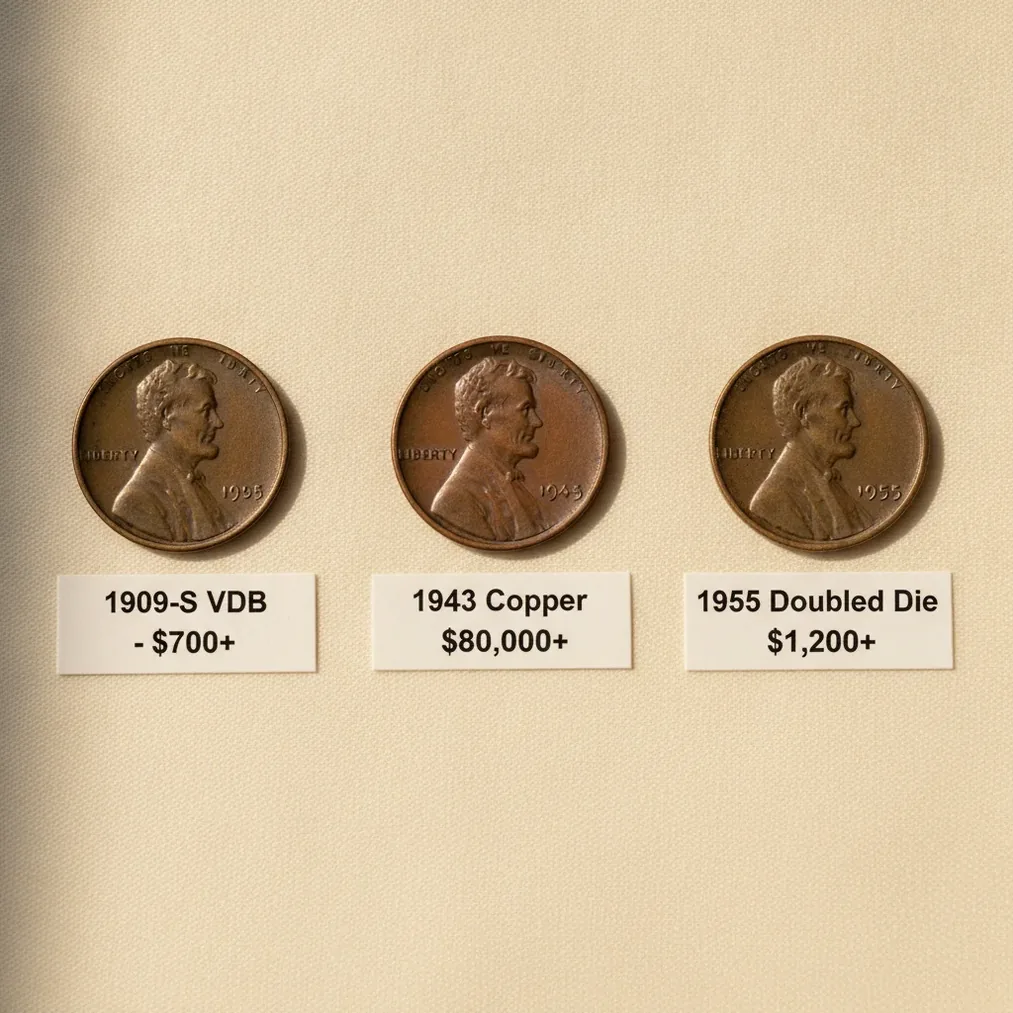
Quick answer: To identify what pennies are worth money, start with the 1909-S VDB, 1943 copper cent, and genuine 1955 doubled die obverse. Circulated 1909-S VDB cents commonly range from about $700 to $1,500, while circulated 1955 doubled dies can bring roughly $1,000 to $3,000. A genuine, problem-free 1943 copper cent may be worth $150,000 or more. Most ordinary wheat cents and circulated 1943 steel cents are worth only $0.01 to $0.15.
Last updated: August 19, 2026
How to check the value from a photo
Photograph both sides
Take clear, close photos of the obverse and reverse in even light. Keep the date, lettering, wheat design, mint mark, and V.D.B. initials in focus.
Identify the date and mint mark
Check for the small S below the date on a possible 1909-S VDB, then look for V.D.B. at the bottom of the reverse. A 1909 VDB without the S is generally much less valuable.
Check the suspected variety
For a 1955 doubled die, inspect 1955, LIBERTY, and IN GOD WE TRUST for bold doubling. For a 1943 cent, remember that the normal steel version is usually worth only a few cents.
Compare grade and sales
Use the photo to estimate wear, surface quality, and color, then compare the coin with certified examples in the same grade. Photo tools can narrow the range, but valuable candidates should be authenticated before sale.
Valuable Pennies and Their 2025–2026 Values
The top cents to look for are the 1909-S VDB, 1943 copper cent, and 1955 doubled die obverse. Their values range from about $700 for a worn 1909-S VDB to $150,000 or more for a genuine 1943 copper error, while most wheat cents remain below $0.15.
| Penny or variety | Typical condition | Approximate value |
|---|---|---|
| 1909-S VDB | Good to Fine | $700–$1,100 |
| 1909-S VDB | Very Fine | $900–$1,500 |
| 1909-S VDB | MS-63 to MS-65 RD | $3,000–$15,000 |
| 1909-S VDB | MS-67 RD | $100,000+ |
| 1909 VDB without S | Most circulated grades | $15–$100 |
| 1943 copper cent | Problem-free example | $150,000+ |
| 1943 steel cent | Circulated | $0.01 to a few cents |
| 1955 doubled die | Good to Very Fine | $1,000–$3,000 |
| 1955 doubled die | XF to Mint State | $3,000–$65,000 |
| Common wheat cent | Mixed circulated | $0.03–$0.15 |
These are approximate retail ranges for certified, problem-free coins. PCGS, NGC, CDN/Greysheet, USA Coin Book, and documented 2025 sales show that grade and color can move the same date from hundreds to many thousands of dollars.
You can find out what your item is worth in seconds with a single clear photo.
Rare Pennies to Look For
Start with the date, mint mark, reverse initials, and obvious design errors. A valuable date is not enough by itself: the 1909-S VDB needs both the S mint mark and V.D.B. initials, while the major 1955 variety needs strong doubling.
1909-S VDB Lincoln cent
Look for a small S below the 1909 date on the obverse and V.D.B. at the bottom of the wheat reverse. Newman Numismatic Portal reported a mintage of approximately 484,000, and PCGS and CDN/Greysheet data place solid circulated examples in the high hundreds to low thousands.
1943 copper cent
The valuable 1943 cent is the wrong-planchet copper error, not the normal steel issue. PCGS and NGC coverage through 2025 places genuine, problem-free copper examples around $150,000 or more, with reported auction records above $200,000.
1955 doubled die obverse
The genuine variety has bold doubling on the date and the words LIBERTY and IN GOD WE TRUST. NGC’s 2022 feature, using guide data current through 2025, lists Brown examples from about $1,150 in Good to $8,500 in MS-65.
How Condition and Color Affect Penny Value
Condition and original color can change a valuable penny’s price by tens of thousands of dollars. A circulated 1955 doubled die may be worth $1,000 to $3,000, while NGC lists an MS-66 Red example at as much as $65,000.
For 1955 doubled dies, NGC’s guide current through 2025 gives Brown coins a range from about $1,150 in Good to $8,500 in MS-65. Red-Brown examples range from approximately $2,900 in MS-60 to $18,500 in MS-66, while Red examples range from about $4,400 in MS-62 to $65,000 in MS-66.
The same pattern applies to the 1909-S VDB. Typical worn pieces trade in the hundreds or low thousands, MS-63 to MS-65 Red coins can reach $3,000 to $15,000, and the finest certified examples have reached six figures. Cleaning, damage, uncertain authenticity, and weak photos can prevent an accurate comparison with problem-free certified coins.
Documented Penny Sales
Recent sold prices show what buyers actually paid for certified 1909-S VDB cents, from $660 for Good-4 to $99,000 for MS-67 RD in 2025. Grade, color, certification, and sale venue explain why identical dates can produce very different results.
| Coin | Venue and year | Sold price |
|---|---|---|
| 1909-S VDB, MS-67 RD PCGS | Heritage Auctions, January 2025 | $99,000 |
| 1909-S VDB, VF-20 ANACS | Heritage Auctions, April 2025 | $1,320 |
| 1909-S VDB, VF-25 PCGS | Heritage Auctions, December 2025 | $1,020 |
| 1909-S VDB, Fine-12 NGC | Heritage Auctions, 2025 | $840–$870 |
| 1909-S VDB, AU-55 PCGS | Heritage Auctions, March 2025 | $1,680 |
| 1909-S VDB, AU-58 PCGS | Stack’s Bowers, March 2025 | $1,740 |
| 1909-S VDB, MS-67 RD PCGS | Stack’s Bowers, April 2022 | $168,000 |
Newman Numismatic Portal also lists at least eight sales from February through March 2025, ranging from $660 for Good-4 to $2,880 for MS-64 Brown.
Valuable Penny Myths
Most old-looking pennies are not rare, and age alone does not create a high value. Common 1943 steel cents, ordinary wheat cents, and 1909 VDB cents without an S usually sell for pennies or modest collector prices.
| Myth | Reality |
|---|---|
| Every 1943 penny is worth thousands. | Normal circulated steel cents are generally worth $0.01 to a few cents. The 1943 copper error is the six-figure rarity. |
| Every 1909 VDB is a major key date. | Circulated Philadelphia 1909 VDB cents without an S often bring about $15–$30, according to USA Coin Book and Greysheet data. |
| Every wheat penny is valuable. | Common circulated wheat cents from the 1930s–1950s usually sell for $0.03–$0.15 each in bulk. |
| Any blurry lettering on a 1955 cent is the doubled die. | Minor machine doubling is worth little more than face value. The genuine variety has bold, clear doubling on the date and lettering. |
Other wheat-cent keys named in hobby references include 1914-D, 1922 no-D, and 1931-S, but a date should be authenticated before assigning a rare-coin price.
How Penny Values Are Estimated
A useful estimate combines correct identification, condition, color, certification status, and dated sold comparables. A photograph can suggest a variety and price range, but it cannot establish authenticity or a certified grade.
This guide uses approximate 2025–2026 retail ranges from PCGS, NGC, CDN/Greysheet, USA Coin Book, and PriceCharting, then checks those ranges against documented Heritage Auctions and Stack’s Bowers sales. Asking prices are less persuasive than completed sales, and comparisons should use the same variety and a similar grade.
For a potentially valuable coin, compare its details with authenticated reference images and avoid assuming that wear, glare, or minor strike distortion is a major error. This page was last reviewed August 19, 2026.
Compare the date, S mint mark, V.D.B. initials, and certified grades with the PCGS 1909-S VDB reference before assigning a value.
Check it with one photo
The scanner on this page gives you one free check. For unlimited scans, sold-price comparisons, and identification of coins, antiques, cards, and more, the free Lens app does the same job from your phone camera.
Frequently Asked Questions
Which wheat pennies are worth money?
For collectors researching what pennies are worth money, the 1909-S VDB is a major wheat-cent key, with circulated examples generally worth about $700–$1,500. Most common wheat cents from the 1930s–1950s are worth only $0.03–$0.15 each unless they have a rare date, major error, or exceptional grade.
How much is a 1909-S VDB penny worth?
Worn Good-to-Fine examples commonly range from $700 to $1,100, while solid Very Fine coins can bring $900 to $1,500. High-grade Red examples may reach $3,000–$15,000, and a PCGS MS-67 RD sold for $99,000 at Heritage Auctions in 2025.
Is every 1943 penny valuable?
No. A normal circulated 1943 steel cent is generally worth $0.01 to a few cents, while a genuine 1943 copper wrong-planchet error may be worth $150,000 or more.
How can I identify a 1955 doubled die penny?
The true 1955 doubled die shows strong, unmistakable doubling on 1955, LIBERTY, and IN GOD WE TRUST. Slight distortion or minor machine doubling is not the major variety and may add little beyond face value.
How accurate are photo value estimates for pennies?
A sharp photo can help identify the date, mint mark, visible variety, and approximate condition, producing a useful comparison range. It cannot confirm authenticity or assign a certified grade, especially for a possible $1,000 or six-figure coin.
Are pennies without mint marks valuable?
Some can be, but the absence of a mint mark does not automatically indicate rarity. For example, a circulated 1909 Philadelphia VDB without an S often sells for about $15–$30 rather than the $700–$1,500 associated with many circulated 1909-S VDB cents.
Should I clean an old penny before checking its value?
Do not use a cleaned coin as though it were a problem-free example when comparing prices. The supplied retail ranges apply to attractive, problem-free coins, and surface issues can prevent an accurate match with certified sales.