 HowMuchIsIt
Are $2 Bills Worth Anything?
If you are wondering “are 2 dollar bills worth anything?”, most are worth $2, but certain red seals, star notes, old series, and scarce serial numbers command premiums.
Drop a photo of are 2 dollar bills worth anything here or tap to check its value
JPG, PNG, WebP, HEIC • Max 50MB • 1 free scan

Analyzing with AI…
Identifying the item and matching value clues


Quick answer: For anyone asking “are 2 dollar bills worth anything?”, most circulated modern $2 bills are worth their $2 face value, while uncirculated examples typically bring $5–$20. Common 1953 and 1963 red-seal notes are generally worth $4–$12 circulated or $10–$25 uncirculated. Scarcer 1928 red seals can reach $10–$150+, and a 1928B may be worth $100–$1,000+. Star notes and genuinely scarce serial numbers can be valuable, but a star or unusual-looking number does not automatically make a bill rare.
Last updated: August 19, 2026
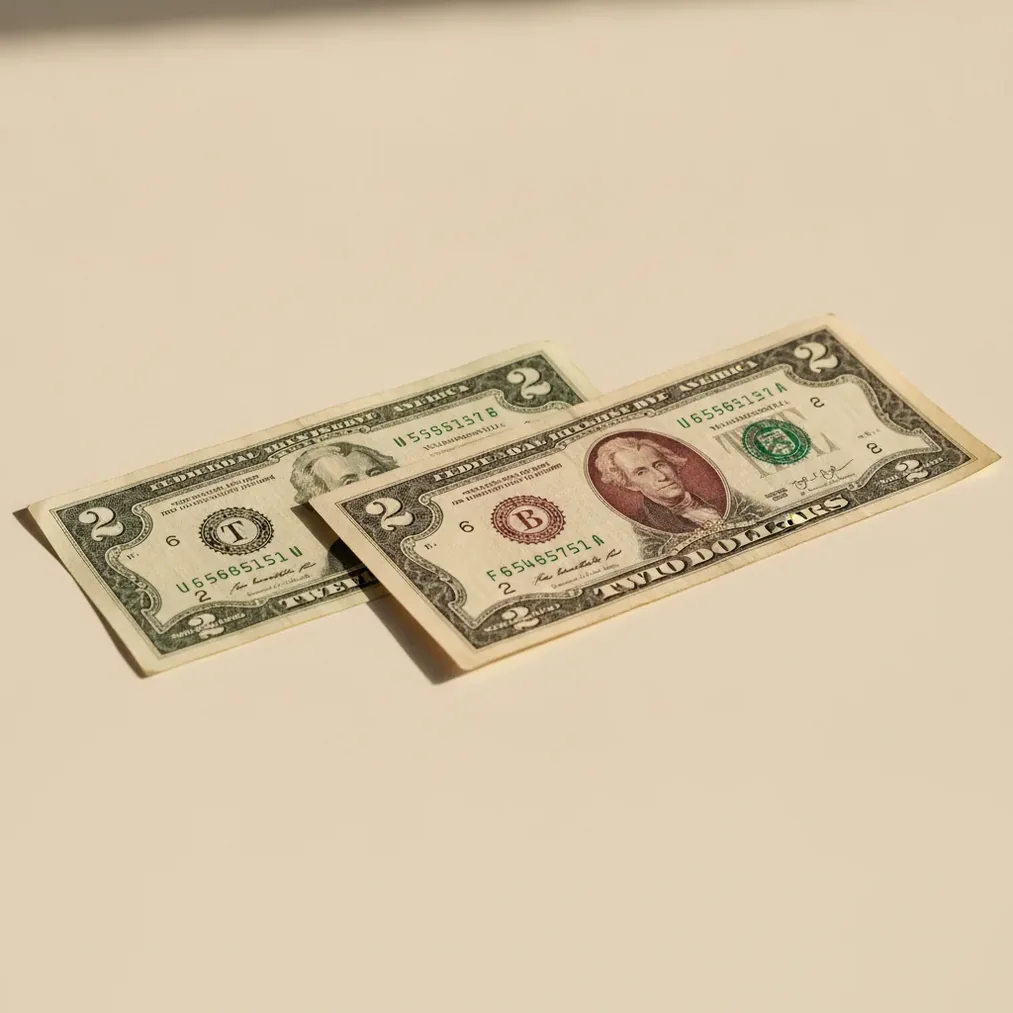
How to check the value from a photo
Photograph the entire front
Place the bill flat in bright, indirect light and take a straight, sharp photo. Keep the seal, series year, signatures, margins, and full serial number visible.
Capture the seal and series
Take a closer photo of the colored seal and printed series year. A green seal generally indicates a modern Federal Reserve note, while collectible older United States Notes usually have red seals.
Photograph the serial number
Get a clear close-up showing every digit and any star. Low numbers, repeats, ladders, solids, radars, and replacement stars can affect the 2 dollar bill value.
Estimate, then verify
Use the photos to compare the exact series, seal, serial feature, and condition with the table below or a tool such as Lens. A photo estimate cannot certify authenticity or assign a professional currency grade.
$2 Bill Value by Series, Seal, and Variety
Most modern green-seal notes are worth $2–$3 circulated, while older red seals and selected star notes carry larger premiums. These 2 dollar bill value ranges summarize the supplied 2025–2026 collector research; actual offers depend on condition, scarcity, and buyer demand.
| Bill or variety | Typical collector value | Key point |
|---|---|---|
| 1976–present green seal, circulated | $2–$3 | Usually worth face value |
| Modern green seal, uncirculated | $5–$20 | Crisp notes and original packs do better |
| 1976 star note | $3–$10 circulated; $20+ uncirculated | District and condition affect demand |
| 2003 star note | $5–$25 | Low print runs or fancy serials may bring more |
| 2013 or later star note | $2–about $5 | Most are not rare |
| 1953 red seal | $4–$12 circulated; $10–$25 uncirculated | A common collectible issue |
| 1953A, 1953B, or 1953C red seal | Usually similar to 1953 | Condition often matters more than the suffix |
| 1963 red seal | $4–$12 circulated; $10–$25 uncirculated | Usually carries a modest premium |
| 1928 red seal | $10–$50 circulated; $25–$150+ uncirculated | Scarcer than 1953 and 1963 issues |
| 1928B red seal | $100–$1,000+ | A key scarce early variety |
| Genuinely scarce serial number | A few dollars to hundreds+ | The exact pattern and scarcity must be verified |
You can also estimate your item’s resale value from one clear photo.
Which $2 Bills Are Worth the Most Money?
For collectors asking “are 2 dollar bills worth anything?”, the strongest candidates are 1928B red seals, scarce star notes, very low serial numbers, and exceptional certified notes. These rare 2 dollar bills differ from common 1953, 1963, and modern green-seal bills, which generally produce much smaller premiums.
- Red seals: Check whether the series is 1928, 1953, or 1963. A 1928B can bring $100–$1,000+, while common circulated 1953 and 1963 notes usually bring $4–$12.
- Star notes: A star marks a replacement note, but scarcity varies. A 1976 star note may be $3–$10 circulated, whereas most 2013-and-later stars remain near $2–$5.
- Low serial numbers: Numbers with very few nonzero digits can attract collectors. The documented L00000007 example shows why exact serials matter.
- Fancy serials: Repeats, ladders, solids, and radars may add value when the pattern is complete and genuinely scarce.
- High grades: Older red seals and scarce stars certified as exceptional gems can exceed $100.
How Condition Changes a $2 Bill’s Value
Condition can move a common bill from face value to a modest premium, but age alone does not create value. A modern uncirculated note may bring $5–$20, compared with $2–$3 for a circulated example.
Collectors look for crisp paper, sharp corners, clean surfaces, strong printing, and original paper quality. Folds, rounded corners, stains, writing, tears, bleaching, and other alterations reduce value. A bill that initially appears mint but shows handling under good light may not qualify as uncirculated.
Do not flatten, wash, bleach, iron, tape, or trim a note. Those changes can damage the paper and eliminate the original qualities sought by currency collectors. Photo-based tools can identify visible features, but they cannot reliably determine an exact professional grade from one image.
A Real High-Value $2 Bill Sale
A 2003 $2 Federal Reserve star note with serial number L00000007 reportedly sold for $2,400 at Heritage Auctions in 2022 and for $4,000 in a resale two weeks later. The Spokesman-Review reported the transactions in 2025.
This result is not representative of an ordinary 2003 bill. Its extremely low serial number and star-note status separate it from typical 2003 star notes valued around $5–$25 in the supplied collector research. No other venue-and-price sale in the provided research was detailed enough to present as an independently verifiable sold comparison.
When evaluating a comparable, match the series, seal, star status, serial pattern, condition, and certification rather than comparing only the denomination. Asking prices are not the same as completed sales.
Myths About Rare $2 Bills
When people ask “are 2 dollar bills worth anything?”, the claim that every $2 bill is rare can cause confusion; most circulated modern examples are worth exactly $2. The Bureau of Engraving and Printing says the modern Federal Reserve version returned in 1976 and remains circulating currency.
- Myth: Every red seal is worth hundreds. Common circulated 1953 and 1963 red seals generally bring only $4–$12.
- Myth: Every star note is rare. Most 2013-and-later stars are worth face value to about $5.
- Myth: Any unusual serial is valuable. A pattern must be complete, recognizable, and scarce; a number that simply looks interesting may add nothing.
- Myth: An old bill is automatically valuable. Series and variety matter, but damage can keep a common old note in the low double digits.
- Myth: Not seeing $2 bills makes them rare. Limited everyday visibility does not establish collector scarcity.
How This $2 Bill Value Guide Was Prepared
For readers asking “are 2 dollar bills worth anything?”, this guide uses the supplied 2025–2026 collector ranges, Bureau of Engraving and Printing denomination history, and the one fully detailed reported sale in the research. It gives broad market ranges rather than a guaranteed offer or certified appraisal.
Start by identifying seal color, series year, star status, and the complete serial number. Then assess folds, corners, stains, tears, writing, and paper originality before selecting the closest table row. Authentication is still necessary when a note appears altered, counterfeit, or unusually valuable; matching currency size, weight, or feel is not proof.
Last reviewed: August 19, 2026.
For official denomination history and design information, see the BEP $2 note guide.
Check it with one photo
The scanner on this page gives you one free check. For unlimited scans, sold-price comparisons, and identification of coins, antiques, cards, and more, the free Lens app does the same job from your phone camera.
Frequently Asked Questions
How much is a 1976 $2 bill worth?
A circulated 1976 green-seal bill is typically worth $2–$3, while an uncirculated modern note may bring $5–$20. A 1976 star note is generally $3–$10 circulated and $20+ uncirculated.
How much is a red-seal $2 bill worth?
Common 1953 and 1963 red seals typically bring $4–$12 circulated or $10–$25 uncirculated. A 1928 red seal may bring $10–$50 circulated, while the scarcer 1928B can reach $100–$1,000+.
Are $2 bills with a star worth more?
Some are, but a star is not automatic proof of rarity. Typical 2003 star notes range from $5–$25, while most 2013-and-later star notes remain near $2–$5.
What serial numbers make a $2 bill valuable?
Very low numbers and complete collectible patterns such as repeats, ladders, solids, and radars may command premiums. Values range from a few dollars to hundreds+, so the exact serial and its scarcity must be checked.
Are 1953 and 1963 $2 bills rare?
Common 1953 and 1963 red-seal notes are collectible but not generally rare. Circulated examples usually sell in the $4–$12 range unless condition, a star, or another scarce feature adds value.
Can a modern $2 bill be worth hundreds of dollars?
Yes, but only exceptional examples such as genuinely scarce low serials, fancy serials, rare star notes, or certified gem notes reach that level. Most circulated modern bills remain worth $2–$3.
How accurate are photo value estimates for $2 bills?
A clear photo can identify the series, seal, star, serial pattern, and visible condition problems, which supports a useful preliminary range. It cannot authenticate the paper, detect every alteration, or replace professional grading for a potentially valuable note.