 HowMuchIsIt
Comic Book Value Checker
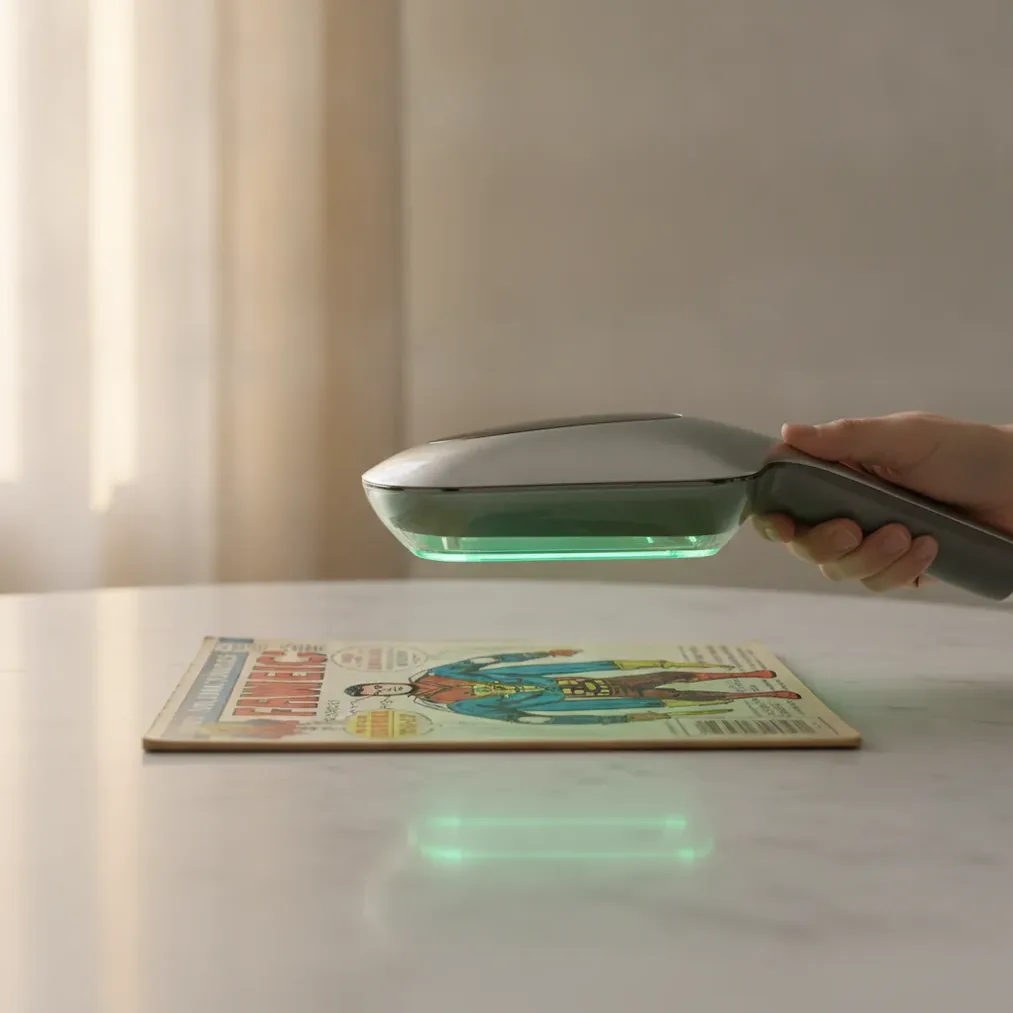
Use the comic book value checker with Lens to photograph the cover, identify the issue, estimate its grade and compare its potential value with recent market results.
Drop a photo of comic book here or tap to check its value
JPG, PNG, WebP, HEIC • Max 50MB • 1 free scan

Analyzing with AI…
Identifying the item and matching value clues


Quick answer: Most common late-Bronze and Modern comics are worth about $1–$50 each, while collector-grade keys typically bring $50–$1,000. Major first appearances in strong condition can sell for $1,000–$50,000+, and elite Silver Age keys can reach six or seven figures, per 2025–2026 market guides. Accurate values depend on the exact issue, printing, variant, condition, restoration and CGC grade. A photo checker provides an initial estimate, but valuable books should be inspected for interior defects and restoration before sale.
Last updated: August 19, 2026
How to check the value from a photo
Photograph the full cover
Place the comic on a flat surface and capture the title, issue number, cover price and all four corners. Avoid glare, bags or cropped edges.
Confirm the exact edition
Use the Lens result as a starting point, then verify the publication year, issue number, newsstand or direct edition, price variant and any retailer-exclusive cover.
Record visible condition
Photograph the spine, back cover and major defects. Creases, water damage, writing, detached covers, missing pages and color touch can reduce the price sharply.
Compare equivalent sales
Match raw comics with raw sales and graded comics with the same CGC grade and label type. Give more weight to recent completed sales than active asking prices.
How Much Are My Comics Worth?
Most individual comics are worth $1–$50, but recognizable key issues commonly reach $50–$1,000. Major first appearances in high grade can exceed $1,000, while elite Silver Age books may sell for $50,000 to seven figures, per 2025–2026 market guides.
| Comic type | Typical value | What usually qualifies |
|---|---|---|
| Common issue | $1–$50 | Late-Bronze or Modern non-key, including many heavily printed issues |
| Minor raw key | $30–$150 | Minor first appearance or common key in mid grade |
| Collector-grade key | $150–$800 | Better-known first appearance in solid mid-to-high grade |
| Major key | $800–$3,000+ | Important Bronze Age key, raw or lightly graded |
| High-end graded key | $1,000–$50,000+ | Major character, scarce issue and strong CGC grade |
| Elite Silver Age key | $50,000–$1.5 million | A book such as Amazing Fantasy #15, depending on grade |
These ranges are starting points rather than guaranteed sale prices. A non-key issue from the same series can remain near its original cover price even when a famous first appearance is worth thousands.
You can also estimate your item’s resale value from one clear photo.
What Makes a Comic Book Valuable?
First appearances, key story events, scarcity and condition create the largest premiums. Age alone does not make a comic valuable: millions of surviving copies can keep even a 30-year-old book under $50.
| Factor | Effect on value |
|---|---|
| Key status | First appearances such as Spider-Man in Amazing Fantasy #15, Punisher in ASM #129 and Venom in ASM #300 receive strong premiums. |
| Era | Golden Age and Silver Age superhero keys can reach six or seven figures; Bronze Age keys often occupy the middle and high tiers. |
| Grade | CGC uses a 0.5–10.0 scale. Price can multiply several-fold between grades such as 6.0, 8.0 and 9.4+. |
| Print run | X-Men #1 reportedly had 8.1 million copies, Spawn #1 had 1.7 million and Youngblood #1 had 1 million, limiting scarcity. |
| Variant | Scarce newsstand editions, price variants and limited retailer variants can command premiums when correctly identified. |
| Restoration | Color touch, trimming and re-glossing generally reduce value compared with an unrestored copy at the same numeric grade. |
Recent Comic Book Sales and Market Examples
Recent examples range from $5 for overprinted 1990s comics to a reported $15 million for Action Comics #1. These results show why the title, issue, grade and label must all match before using a sale as a comparable.
| Comic or event | Price | Venue and year |
|---|---|---|
| Action Comics #1, first Superman | $15 million | Private or consortium sale reported in 2026 |
| Detective Comics #27, CGC 8.5 Restored | $520,950 | ComicConnect, 2025 |
| Early Detective Comics and Batman keys | $22.38 million event total | Heritage Auctions, 2026 |
| Amazing Fantasy #15 | $50,000–$1.5 million | Major venues, 2025–2026, depending on CGC grade |
| Amazing Spider-Man #1 | $8,000–$150,000 | Auctions and high-end marketplaces, 2025–2026 |
| Amazing Spider-Man #129 | $300–$2,800 | eBay and specialist auctions, 2025–2026 |
| Amazing Spider-Man #300 | $300–$2,000 | Secondary market, 2025–2026 |
| X-Men #1, Spawn #1 or Youngblood #1 in CGC 9.8 | $5–$30 | Secondary markets, 2024–2026 |

How Condition and CGC Grading Affect Value
Condition can move the same key issue from hundreds of dollars to thousands, particularly above CGC 8.0. Modern keys are often priced around the CGC 9.8 benchmark, while restored labels generally sell below unrestored copies with the same number.
Check the spine for ticks and roll, then inspect corners, gloss, creases, tears, stains and writing. Water damage, missing pages, detached covers and amateur color touch can cause major reductions. A potential 9.8 copy needs sharp corners, clean gloss and minimal spine wear.
A cover photograph cannot reveal every interior defect, restoration technique or missing page. Do not clean, press, trim or recolor a potentially valuable comic without qualified advice, because an altered book may receive a different label or lower market price.
How the Comic Book Value Estimate Works
A comic book value checker identifies the likely issue from a photo and places it within a market range using comparable 2024–2026 prices. It is not a certified appraisal or a guaranteed offer, and accuracy falls when the edition, interior condition or restoration status cannot be confirmed.
- Read the title, issue number, cover details and visible edition markers.
- Determine whether the book is a first appearance, origin, first solo title or other key.
- Estimate a condition range from visible defects rather than assuming a CGC grade.
- Compare recent results for the same issue, edition, grade and restoration status.
- Separate active asking prices from completed sales and provide a realistic range.
Last reviewed: August 19, 2026.
Where to Sell Valuable Comic Books
eBay may suit comics with frequent comparable sales, while ComicConnect, Heritage Auctions and other specialist auction houses handle major graded keys. Trophy books valued in the six or seven figures may also trade through private or consortium sales.
Match the venue to the comic and document the exact CGC grade, label, restoration status and variant. Amazing Spider-Man #129 had a reported $300–$2,800 market range in 2025–2026, so listing it without a condition assessment can produce an unrealistic expectation. For a raw high-value key, professional inspection may be more useful than relying only on a cover photograph.
Review specialist listings and reported auction activity through the ComicConnect auction marketplace before choosing where to sell a major key.
Check it with one photo
The scanner on this page gives you one free check. For unlimited scans, sold-price comparisons, and identification of coins, antiques, cards, and more, the free Lens app does the same job from your phone camera.
Frequently Asked Questions
How accurate are photo comic book value estimates?
A clear cover, spine and back-cover photo can identify many issues and support an approximate $1–$50, $50–$1,000 or higher value tier. It cannot confirm missing pages, interior damage, restoration or an exact CGC grade, so expensive keys need closer inspection.
Are all old comic books valuable?
No. Non-key issues can sell near cover price, while Golden and Silver Age first appearances may reach $50,000 or more. Character importance, scarcity and grade matter more than age alone.
Does CGC grading increase comic book value?
CGC grading documents a 0.5–10.0 grade and label status, making comparisons easier. A high grade can support a premium, but overprinted books such as X-Men #1, Spawn #1 and Youngblood #1 may still bring only $5–$30 in CGC 9.8.
What comic book first appearances are valuable?
Major examples include Spider-Man in Amazing Fantasy #15, Punisher in Amazing Spider-Man #129 and Venom in Amazing Spider-Man #300. Their reported 2025–2026 ranges run from $300 for lower-priced examples to $1.5 million for top Silver Age material.
Are 1990s comics worth money?
Most mass-printed 1990s issues are worth little because supply remains high. True keys such as New Mutants #98, ASM #361, Preacher #1 and Batman Adventures #12 were generally worth $220–$1,650 in CGC 9.8 in 2026.
How does restoration affect comic book values?
Color touch, trimming and re-glossing generally reduce value compared with an unrestored comic at the same numeric grade. A restored Detective Comics #27 graded CGC 8.5 sold for $520,950 at ComicConnect in 2025, but restored and unrestored results should not be treated as equivalent.
Should I grade my comic before selling it?
Grading is most relevant when the issue is a genuine key and the expected price difference between grades could be substantial. A $5–$30 mass-printed comic does not have the same grading case as a book potentially worth $300, $3,000 or $50,000.