 HowMuchIsIt
What Nickels Are Worth Money?
Key dates, silver war nickels, errors and top-grade Full Steps coins can be worth $1 to millions.
Drop a photo of what nickels are worth money here or tap to check its value
JPG, PNG, WebP, HEIC • Max 50MB • 1 free scan

Analyzing with AI…
Identifying the item and matching value clues


Quick answer: For collectors asking what nickels are worth money, examples include the 1913 Liberty Head, 1918/7 overdate, 1926-S and 1927-S Buffalo, 1937-D Three-Legged Buffalo, 1950-D Jefferson and 1942–45 silver war nickels. Values range from about $1–$4 for circulated war nickels to roughly $4.5 million for a 1913 Liberty Head example. Condition matters: a 1965 Jefferson graded PCGS MS66 Full Steps sold for $29,250 in 2025, while most circulated 1964 nickels remain worth $0.05. Authentication and professional grading are essential before assigning a five-figure or higher value.
Last updated: August 19, 2026
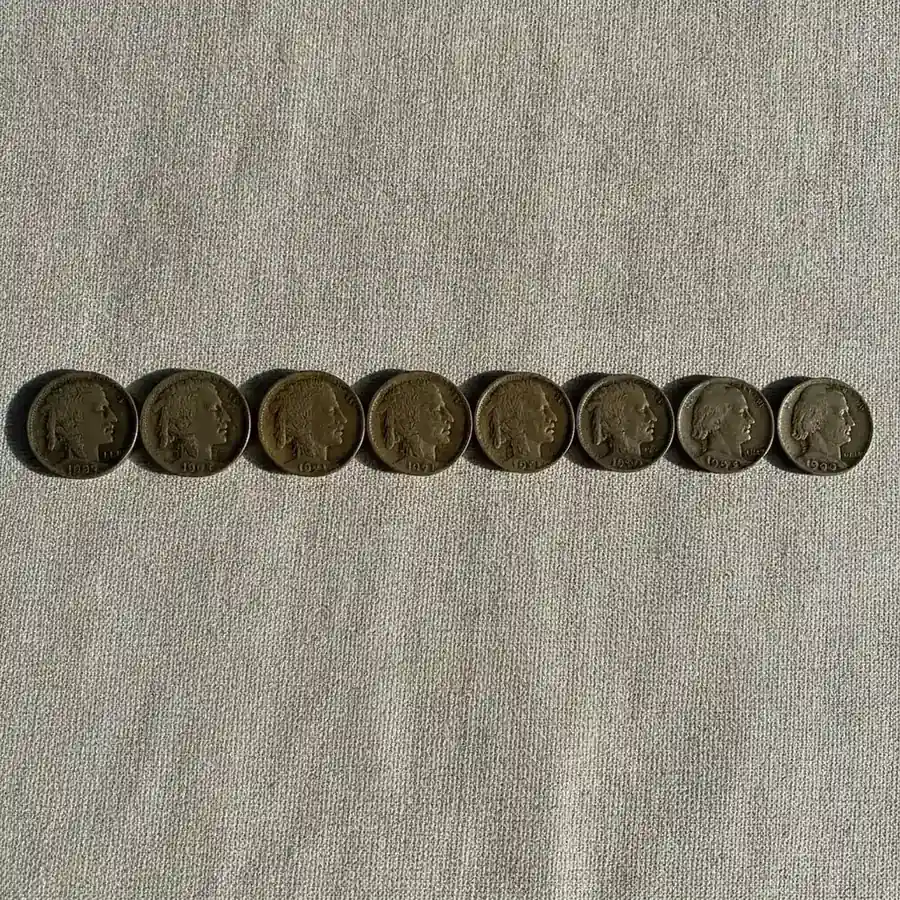
How to check the value from a photo
Photograph both sides
Place the nickel on a plain surface and take sharp, glare-free photos of the obverse and reverse. Include close-ups of the date, mintmark, Monticello steps and any suspected error.
Identify the design and date
Determine whether it is a Liberty Head from 1883–1912, Buffalo from 1913–1938 or Jefferson from 1938 onward. A photo tool such as Lens can help organize visible details, but it cannot authenticate a rarity.
Compare the variety
Check the images for key markers such as the 1937-D missing front leg, a 1918/7 overdate, a large war-nickel mintmark or sharply separated Monticello steps. Do not rely on the date alone.
Confirm condition and sales
Compare the coin with dated auction results for the same variety and grade. If the apparent value is substantial, obtain authentication and grading because photos cannot reliably establish metal composition, alteration or an exact numeric grade.
Valuable Nickels to Look For
The nickels with the highest values are scarce dates, recognized varieties, silver war issues and exceptional Full Steps Jefferson coins. Most ordinary circulated Jefferson nickels are worth $0.05, but confirmed exceptions can sell for $1 to millions.
| Nickel | Feature | 2025–2026 value guidance |
|---|---|---|
| 1913 Liberty Head | Unauthorized issue; five known | About $4.5 million or more at top auction levels |
| 1912-S Liberty Head | Key final-year V nickel | About $10,000 or more in top grades |
| 1912-D Liberty Head | Low mintage | About $2,500 or more in high grades |
| 1918/7 Buffalo | 8 over 7 overdate | $80,000 or more in high grade |
| 1926-S or 1927-S Buffalo | Poor strikes and high attrition | $60,000 or more for high-grade 1927-S; low six figures for the best 1926-S |
| 1937-D Three-Legged Buffalo | Weak or missing front leg | Up to about $100,000 for high-grade examples |
| 1942–45 war nickel | 35% silver; large mintmark above Monticello | Usually $1–$4 circulated; rare varieties can exceed $4,000 in top grades |
| 1950-D Jefferson | Low-mintage key date | Up to about $3,000 or more in top uncirculated grades |
| Jefferson Full Steps | Sharp, complete Monticello steps | Often $20–$100 or more; scarce top-grade coins can reach five figures |
| 2025-S PR70 DCAM | Perfect-grade proof designation | About $35 |
These ranges come from 2025–2026 price-guide summaries and Bullion Shark's 2026 rare-nickel data. They are not guaranteed offers; grade, certification and market demand can change the result.
It takes under a minute to scan an item to check its value.
Real Nickel Auction Sales
Verified sales show that grade and certification can change a nickel's price by tens of thousands of dollars. Three Proof-68 1914 nickels sold from $8,400 to $42,000, demonstrating why the holder and approval status matter.
| Coin | Venue and date | Price |
|---|---|---|
| 1965 Jefferson, PCGS MS66 FS | Major auction reported by Bullion Shark, Dec. 7, 2025 | $29,250 |
| 1914 nickel, CAC-approved Proof-68 | Stack's Bowers, Nov. 11, 2025 | $42,000 |
| 1914 nickel, PCGS Proof-68 without CAC | Stack's Bowers, March 26, 2024 | $11,100 |
| 1914 nickel, NGC Proof-68 without CAC | Stack's Bowers, June 18, 2024 | $8,400 |
| 1964 SMS Jefferson | Record summarized by a specialist source, 2025 | About $32,900 |
| 1927-S Buffalo | Highest recorded value reported by Bullion Shark, 2026 | About $250,000 |
| 1937-D Three-Legged Buffalo | Highest recorded value reported by Bullion Shark, 2026 | About $99,875 |
An auction record is a comparable, not the automatic value of another coin with the same date. A worn, cleaned or uncertified example may sell for far less than a top-grade certified coin.
What Determines an Old Nickel's Value?
Date, mintmark, variety, grade, surface quality and certification determine old nickel values. A rare date in heavy wear may be valuable, while a common date generally needs exceptional preservation, Full Steps or a major mint error to earn a premium.
- Date and mintmark: Key combinations include 1912-S, 1926-S, 1927-S and 1950-D.
- Recognized variety: The 1937-D Three-Legged Buffalo, 1918/7 overdate and 1942-P D over P have specific markers that must match the attributed variety.
- Grade: Wear, marks, luster and strike quality affect the numeric grade. Common uncirculated 1946–1964 Jefferson nickels may be $3–$10, compared with $0.05 for circulated examples in a 2026 dealer table.
- Full Steps: Clearly separated Monticello steps can raise common Jefferson values to $20–$100 or more. A scarce 1965 PCGS MS66 FS reached $29,250 in 2025.
- Errors: Dramatic off-center strikes and doubled dies commonly appear in guide ranges of $50–$500 or more; a high-grade 1942-P D over P is listed above $1,500.
Greysheet's 2024 platform showed Jefferson nickel ranges from $0.20 to $54,500 depending on date, grade and Full Steps status.
How to Identify Rare Nickels
Start with the design, date and mintmark, then inspect only the documented markers for that issue. Magnification and clear photos can reveal a possible variety, but authentication is needed for expensive coins.
- Separate Liberty Head nickels dated 1883–1912, Buffalo nickels dated 1913–1938 and Jefferson nickels dated 1938 to the present.
- On Liberty Head and Buffalo coins, inspect the reverse near “Five Cents” or below the motto for a mintmark. On most early Jefferson nickels, look to the right of Monticello.
- For 1942–45 war nickels, look for a large mintmark above Monticello. These coins contain 35% silver.
- For Jefferson nickels dated 1968 onward, check the obverse near the date for the mintmark.
- Inspect Buffalo varieties for an overdate or missing leg, and Jefferson coins for complete Monticello steps, repunched mintmarks, doubled details or major off-center strikes.
Never clean a coin to make its details clearer. Cleaning can alter the surfaces, complicate grading and reduce collector interest.
Common Nickel Myths and Face-Value Coins
Most 1964 and other common circulated Jefferson nickels are worth only $0.05. Age alone does not create value, and a regular 1964 nickel is neither rare nor silver.
Myth: Every 1964 nickel is valuable
More than 2.8 billion 1964 Jefferson nickels were minted across Philadelphia and Denver, according to 2025–2026 specialist summaries. Some were produced in 1965–1966 under the frozen 1964 date, so ordinary circulated pieces remain at face value.
Myth: A 1964 nickel contains silver
Specialist explanations from 2025 state that standard 1964 nickels use copper-nickel composition and contain no silver. The silver nickels are the 1942–45 war issues with large mintmarks above Monticello.
Myth: Every old Jefferson nickel is worth hundreds
A 2024–2025 collecting guide places worn Jefferson nickels commonly found from the 1940s and 1950s at only $1–$5. A 2026 dealer table values circulated 1946–1964 examples at $0.05, with premiums generally reserved for uncirculated, Full Steps or error coins.
Myth: A new nickel cannot have value
A worn 2025 nickel is worth $0.05, but 2025 MS65–MS67 Full Steps examples can reach about $115 in guide values. A 2025-S PR70 DCAM proof is listed around $35.
Valuation Methodology and Limits
To determine what nickels are worth money, this guide uses 2024–2026 auction results and 2025–2026 market summaries to identify realistic price levels. It separates realized sales from guide estimates and does not treat an automated photo estimate as authentication or a certified appraisal.
First, the coin must match the date, mintmark and documented variety. Next, its visible condition is compared with certified examples, followed by dated sales for the same designation. Price-guide ranges provide context when a recent equivalent sale is unavailable.
Photos may obscure fine scratches, altered surfaces, weak strikes and incomplete Monticello steps. They also cannot prove metal composition or assign a dependable numeric grade. For a suspected 1913 Liberty Head, 1964 SMS, major Buffalo variety or five-figure Full Steps coin, use an established grading and authentication service before selling.
Last reviewed: August 19, 2026. Values are market references rather than purchase offers, and most nickels submitted for review will be worth face value or a small collector premium.
For another market reference covering grade-dependent coin values, review Greysheet coin price data.
Check it with one photo
The scanner on this page gives you one free check. For unlimited scans, sold-price comparisons, and identification of coins, antiques, cards, and more, the free Lens app does the same job from your phone camera.
Frequently Asked Questions
Which nickel dates are worth the most money?
Major dates include the 1913 Liberty Head, 1912-S Liberty Head, 1918/7 Buffalo, 1926-S and 1927-S Buffalo, 1937-D Three-Legged Buffalo and 1950-D Jefferson. The 1913 Liberty Head has reached about $4.5 million, while the others vary sharply by grade.
Are 1964 nickels worth money?
A normal circulated 1964 Jefferson nickel is generally worth $0.05 because more than 2.8 billion were produced across Philadelphia and Denver. Exceptional Full Steps coins, mint errors and the extremely rare 1964 SMS issue are the notable exceptions.
Which nickels contain silver?
U.S. war nickels dated 1942–45 contain 35% silver and have a large mintmark above Monticello. Common circulated examples typically bring $1–$4 in 2025–2026 guidance; regular 1964 nickels contain no silver.
What does Full Steps mean on a Jefferson nickel?
Full Steps indicates that the steps at the base of Monticello are sharply defined and sufficiently complete for the grading designation. Common dates may be $20–$100 or more with Full Steps, while a 1965 PCGS MS66 FS sold for $29,250 in 2025.
How accurate are photo value estimates for nickels?
A clear photo can help identify the design, date, mintmark and possible variety, but it cannot confirm authenticity or an exact grade. Surface alteration, strike quality and tiny step details often require in-person examination.
How can I tell if a Buffalo nickel is rare?
Check the date and reverse mintmark, then look for documented varieties such as the 1918/7 overdate or 1937-D missing front leg. Valuable dates include 1926-S and 1927-S, but grade and authentication determine the actual price.
Should I clean an old nickel before selling it?
No. Cleaning changes the coin's surfaces and can reduce collector interest or prevent it from receiving a normal numeric grade. Photograph and store the coin as found before seeking an opinion.