 HowMuchIsIt
Google Lens for Item Values: What It Can and Cannot Do
Google Lens identifies items and finds asking prices for $0, but a reliable resale estimate usually requires sold-market evidence.
Drop a photo of google lens for item values here or tap to check its value
JPG, PNG, WebP, HEIC • Max 50MB • 1 free scan

Analyzing with AI…
Identifying the item and matching value clues


Quick answer: Google Lens for item values works best for identifying recognizable products and finding current retail or marketplace listings. It is free for consumers, with no subscription or stated usage cap, according to 2025–2026 sources. However, it does not provide sold-price history or a definitive resale value, so asking prices may overstate what buyers will pay. For valuation, use its identification as a starting point and compare the exact model and condition against recent sold results or a value-focused photo tool.
Last updated: August 19, 2026
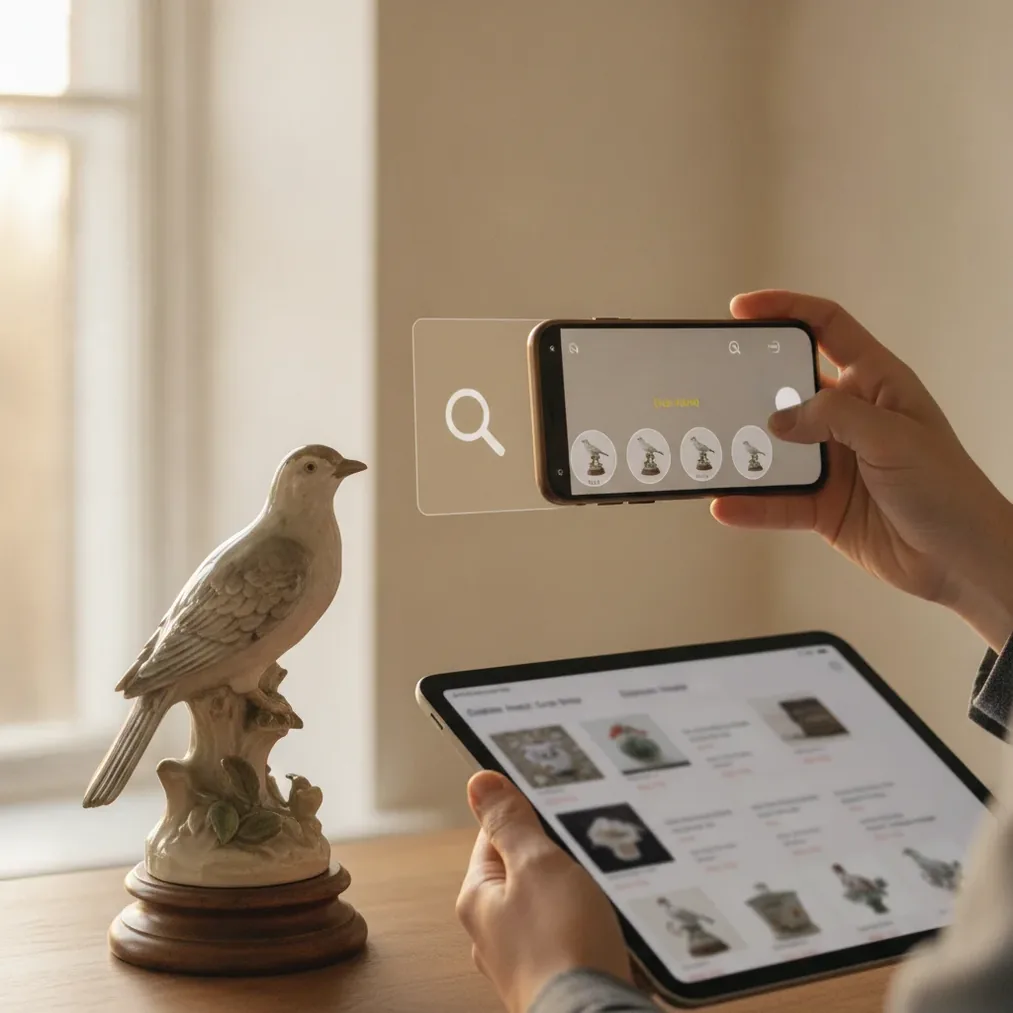
How to check the value from a photo
Photograph the identifying details
Take one clear full-item photo, then capture the brand, model number, maker’s mark, label, pattern, signature or packaging. Exact identifiers reduce visually similar but incorrect matches.
Use visual search to identify it
Run the image through Google Lens and review several matches rather than accepting the first result. Confirm that the model, size, materials, edition and included parts match your item.
Separate asking prices from sold prices
Treat retail offers and active listings as seller expectations, not proof of value. Look for recent completed sales of the same item in comparable condition whenever sold-market data is available.
Set a condition-adjusted range
Compare complete, working examples with damaged, incomplete or untested ones. A photo-based estimate can provide a range, but rare or high-value items may require specialist authentication or appraisal.
Does Google Lens Tell You What an Item Is Worth?
No. Google Lens identifies an item and surfaces visually similar products, current offers and shopping links, but it does not give a definitive resale valuation or sold-price history. Reseller guidance published in 2026 describes it as an identification tool first rather than a true resale pricing engine.
It is useful when you do not know the product name, model or search terms. Google’s visual search can recognize products, books, shoes, toys, homewares, decor, text, plants, animals and landmarks. Once it finds a likely identity, you can use that information to perform a more exact market search.
The limitation is the type of price shown. A retailer may offer an item for $100, or a marketplace seller may ask $100, without any buyer completing a purchase at that amount. Lens does not establish that the item sold for $100, so its results should be treated as price-discovery leads rather than direct value evidence.
The same free tool lets you check an item’s value in any category.
When Google Lens Works Best for Prices
Google Lens works best for common, branded and visually recognizable products with many indexed listings. It can quickly supply a likely product name and current price context at a consumer cost of $0.
- Branded goods: Logos, packaging and recognizable designs can lead to close retail or marketplace matches.
- Books and media: Covers, titles and visible text help distinguish editions.
- Shoes and toys: Model names, colorways and packaging can improve matching.
- Homewares and decor: It can locate visually similar products when the maker is unknown.
- Text and labels: Optical character recognition can extract a model number or maker name for a narrower search.
Use multiple image angles before relying on a match. A visually similar product may have a different size, material, production year or model number, each of which can change its resale value.
Google Lens Pricing, Ratings and Limits
Core consumer Google Lens features cost $0, with no premium tier or stated usage cap in the supplied 2025–2026 sources. Some iOS bundles display optional purchases, while developer image-processing services have separate per-image charges.
| Product or service | Reported price | What the price covers |
|---|---|---|
| Consumer Google Lens | $0 | Object, text and shopping searches in Google’s consumer ecosystem |
| iOS yearly purchase shown in source | $29.99 | Optional in-app purchase; the source does not establish that it is required for core Lens use |
| Cloud Vision label detection | $1.50 per 1,000 images | Developer API service, not ordinary consumer use |
| Cloud Vision text detection | $3.50 per 1,000 images | Developer API service |
| Cloud Vision object localization | $5.00 per 1,000 images | Developer API service |
| Cloud Vision landmark recognition | $2.00 per 1,000 images | Developer API service |
A 2025 Android analytics source reported a 4.68 out of 5 rating from 2,464,430 ratings. A 2026 review-analysis source reported a similar 4.73 average from about 2.8 million ratings. Exact iOS rating figures were not available in the supplied research.
Where Photo Matches Can Produce Misleading Values
Results become less reliable for obscure, unbranded, rare or condition-sensitive items because visual similarity does not prove an exact identity or market value. Retail-biased and active-listing results can also be higher than realistic secondhand sale prices.
Common failure points include a reproduction matched to an original, a later edition matched to an early one, or a damaged item compared with a complete example. Collectibles, antiques and signed items may also require authentication that cannot be established from one general photo.
Condition should be checked separately for cracks, repairs, stains, missing parts, fading, replaced components and whether the item works. Photograph maker’s marks and serial or model numbers where safe to do so. If the match cannot be confirmed, report a broad range or no estimate rather than treating the highest visible asking price as value.
Google provides a consumer overview of supported visual-search uses in its official Google Lens overview.
Google Lens Alternatives for Item Values
A good Google Lens alternative for values should combine photo identification with market evidence rather than showing similar images alone. The available tools differ in whether they claim sold data, live prices, price-guide records or only a direct estimate.
| Tool | Primary use | Value evidence described in research | Reported consumer price |
|---|---|---|---|
| Google Lens | Broad visual identification and shopping search | Current offers and asking prices; no direct sold-price history | $0 |
| Appraiso | Photo identification and valuation | Claims sold and retail data from 100+ marketplaces and 200+ data points | Not supplied |
| WorthPoint | Antiques and collectibles research | Price-guide data plus databases for marks, patterns, symbols and autographs | Not supplied |
| Valuify | Multi-category photo price finder | Claims ranges from live market data and resale insights | Not supplied |
| Pricesnap | Visual price discovery | Claims aggregation from hundreds of sources, new-versus-used comparison and price history | Not supplied |
| Lens on this site | Free photo-based estimate | Direct estimate intended as a starting point, not a certified appraisal | $0 |
Claims about marketplace coverage come from each provider’s descriptions and do not guarantee that an exact item has enough comparable sales. Apps like Google Lens for prices are most useful when they show why a range was selected and allow you to verify the match.
How This Comparison Was Evaluated
This comparison separates identification, asking-price discovery and valuation because they answer different questions. It gives greater weight to exact product matching, recent sold evidence and condition than to the highest visible listing.
- Confirm the developer, supported platforms and consumer cost.
- Determine whether results are retail offers, active listings, price-guide records or completed sales.
- Check whether the tool provides one direct figure, a range or only search results.
- Review rating data and documented limitations without treating ratings as proof of valuation accuracy.
The supplied research did not include dated, item-level sold examples, so none are presented as verified sales here. No photo tool can confirm authenticity, internal condition or undocumented repairs from every image. An automated $0 estimate is not a certified appraisal and should not be used alone for insurance, tax, estate or legal purposes.
Last reviewed: August 19, 2026.
Check it with one photo
The scanner on this page gives you one free check. For unlimited scans, sold-price comparisons, and identification of coins, antiques, cards, and more, the free Lens app does the same job from your phone camera.
Frequently Asked Questions
How accurate is Google Lens for item values?
It can be accurate at identifying common branded products, but it is not designed to calculate resale value. Its shopping results usually reflect retail offers or active asking prices rather than verified sold prices.
Does Google Lens show sold prices?
No. The supplied 2026 reseller research describes Google Lens as an identification tool that does not expose sold-price history. Use the identity it finds to search completed sales elsewhere.
Is Google Lens free for price checking?
Yes. Consumer Google Lens is reported as costing $0 with no subscription, premium tier or usage cap in 2025–2026 sources. Optional iOS purchases and Cloud Vision developer API fees are separate.
Why are Google Lens prices sometimes too high?
Results can favor new retail offers and active marketplace listings. An asking price of $100 does not show that a buyer paid $100, and differences in model, age or condition may make the comparison unsuitable.
What photos improve an item value estimate?
Use a clear full-item image plus close-ups of the brand, model number, label, maker’s mark and damage. Include accessories and packaging because missing components can affect which comparable item is appropriate.
What is the best Google Lens alternative for values?
Choose a tool that identifies the exact item and explains whether its range uses sold records, retail prices or active listings. Appraiso claims real sold data, while WorthPoint focuses on antiques and collectibles price-guide research.
Is a photo value estimate the same as an appraisal?
No. A photo estimate is an automated market starting point, while a certified appraisal may address authenticity, physical inspection and a specific legal or insurance purpose. Rare or high-value items may need a qualified specialist.