 HowMuchIsIt
Toy Value Checker
Upload a clear toy photo to identify the line, compare condition, and estimate its current resale range.
Drop a photo of toy here or tap to check its value
JPG, PNG, WebP, HEIC • Max 50MB • 1 free scan

Analyzing with AI…
Identifying the item and matching value clues


Quick answer: Most ordinary loose 1980s and 1990s toys are worth about $5–$50, while complete vintage figures and boxed toys commonly bring $50–$500. High-grade boxed or sealed pieces generally fall around $150–$1,500+, although scarce graded examples can reach $10,000–$30,000+. Packaging, original accessories, condition, date stamps, character, and rarity have the greatest effect on value. Use a toy value checker as a starting estimate, then verify the result against recent sales of the same version.
Last updated: August 19, 2026
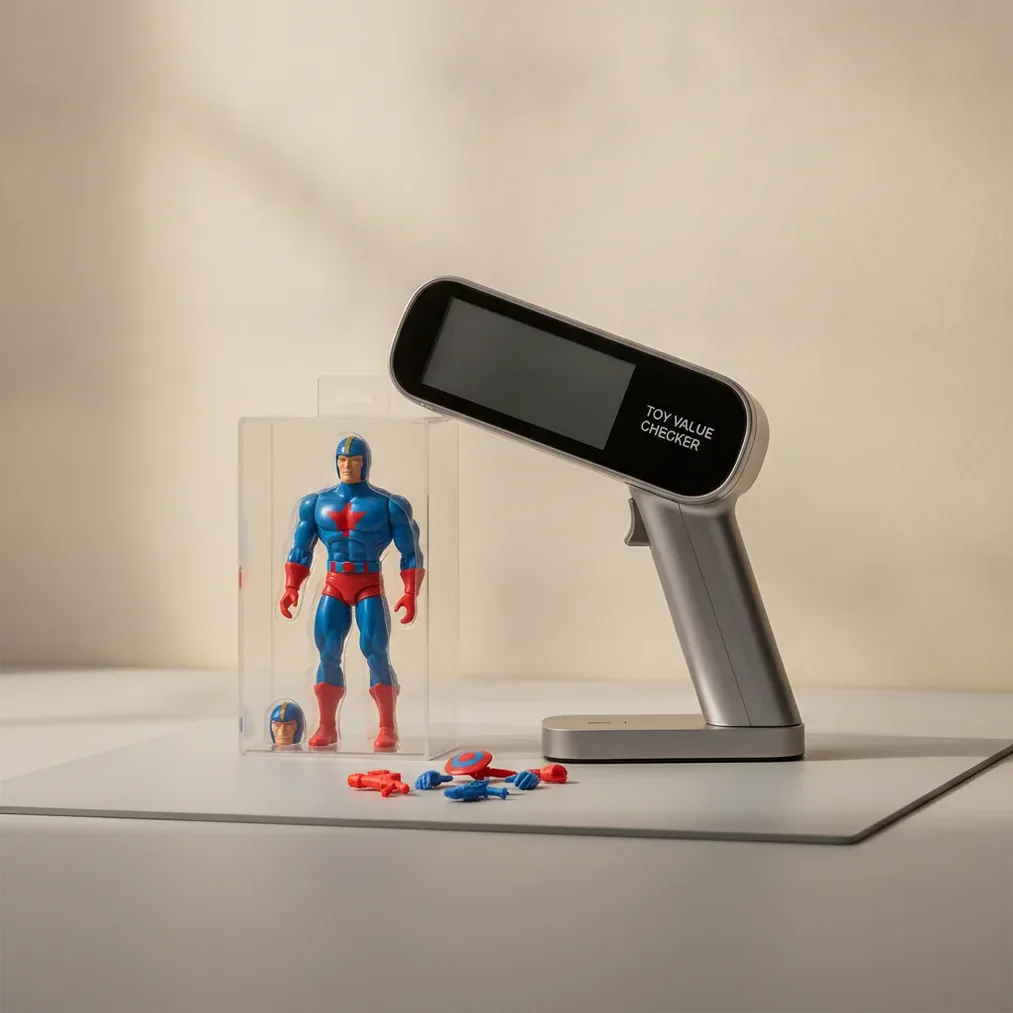
How to check the value from a photo
Photograph the entire toy
Take a well-lit front photo showing the figure, vehicle, doll, set, card, or box. Keep accessories beside the toy so completeness can be assessed.
Capture marks and packaging
Add close photos of molded date stamps, country-of-origin marks, logos, barcodes, copyright lines, and factory seals. These details help separate vintage originals from lower-value reissues.
Review the identification
Use the Lens app or another photo checker to identify the toy line, character, approximate release, and packaging format. Correct any mismatch before relying on a price estimate.
Compare equivalent sales
Match loose toys with loose sales and sealed toys with sealed sales. Compare the same accessories, variant, box condition, grading status, venue, and sale year.
How much are my old toys worth?
Most common loose old toys are worth $5–$50, while complete, boxed, sealed, or unusually scarce pieces can sell from $50 to five figures. The majority are not rare, even when they come from a popular 1980s or 1990s line.
| Value tier | Typical price | What usually fits |
|---|---|---|
| Common loose or incomplete | $5–$30 | Played-with figures, common fast-food toys, mass-market dolls, or toys missing weapons and parts |
| Loose but complete | $30–$200+ | Kenner Star Wars, G.I. Joe, G1 Transformers, Hot Wheels, and similar toys with original accessories |
| Major-line boxed toy | $50–$500 typical | Complete vintage figures, vehicles, and boxed toys; stronger pieces can enter the hundreds or low thousands |
| High-grade boxed or sealed | $150–$1,500+ | MISB or carded examples with limited wear and collector demand |
| Exceptional graded rarity | $10,000–$30,000+ | Scarce key characters, variants, and top-grade sealed Star Wars or G1 Transformers |
These 2025–2026 ranges come from Patina's 2026 vintage-toy overview and recent action-figure market guides. A range is more defensible than a single number because two examples of the same toy can differ sharply in packaging and completeness.
You can also estimate your item’s resale value from one clear photo.
What factors determine vintage toy value?
Condition, completeness, packaging, originality, character, variant, and grading determine what collectors will pay. Missing a small original weapon can keep a figure in the $5–$30 tier instead of the $30–$200+ complete tier.
| Factor | Potential effect | What to check |
|---|---|---|
| Factory-sealed packaging | Often 10–20× loose value | Original tape, card blister, box wear, fading, crushing, and resealing |
| Opened original box | Often 3–8× loose value | Inserts, instructions, paperwork, unused parts, and box damage |
| Completeness | Can move value from $5–$30 to $30–$200+ | Weapons, capes, missiles, stickers, stands, and vehicle pieces |
| Original release | Usually worth more than a reissue | Date stamp, manufacturer, copyright line, and country of origin |
| Professional grading | Key sealed toys can reach $1,000–$50,000+ | AFA, CAS, grade, label details, and case condition |
Patina's 2026 guidance identifies original 1977–1985 Kenner Star Wars, G1 Transformers, G.I. Joe, Hot Wheels Redlines, and early LEGO among lines with collector demand. Popularity alone is insufficient: heavily produced characters can remain below $30–$60 when loose and played with.
Are sealed toys worth more than loose toys?
Sealed vintage toys are frequently worth 10–20 times as much as loose versions, while opened boxed toys may bring 3–8 times loose value. The premium depends on an authentic seal, box condition, rarity, and whether the enclosed toy is complete.
Patina's 2026 overview gives G1 Soundwave as a clear comparison: a loose example may command $100–$200, while a graded sealed example sold for nearly $16,000. Do not open an apparently factory-sealed package simply to photograph the toy; opening it can remove the sealed classification that supports much of its value.
A complete set also needs the correct original parts. Photograph every weapon, accessory, insert, instruction sheet, sticker, and box panel. Replacement accessories may improve display appeal, but they do not make the toy fully original.
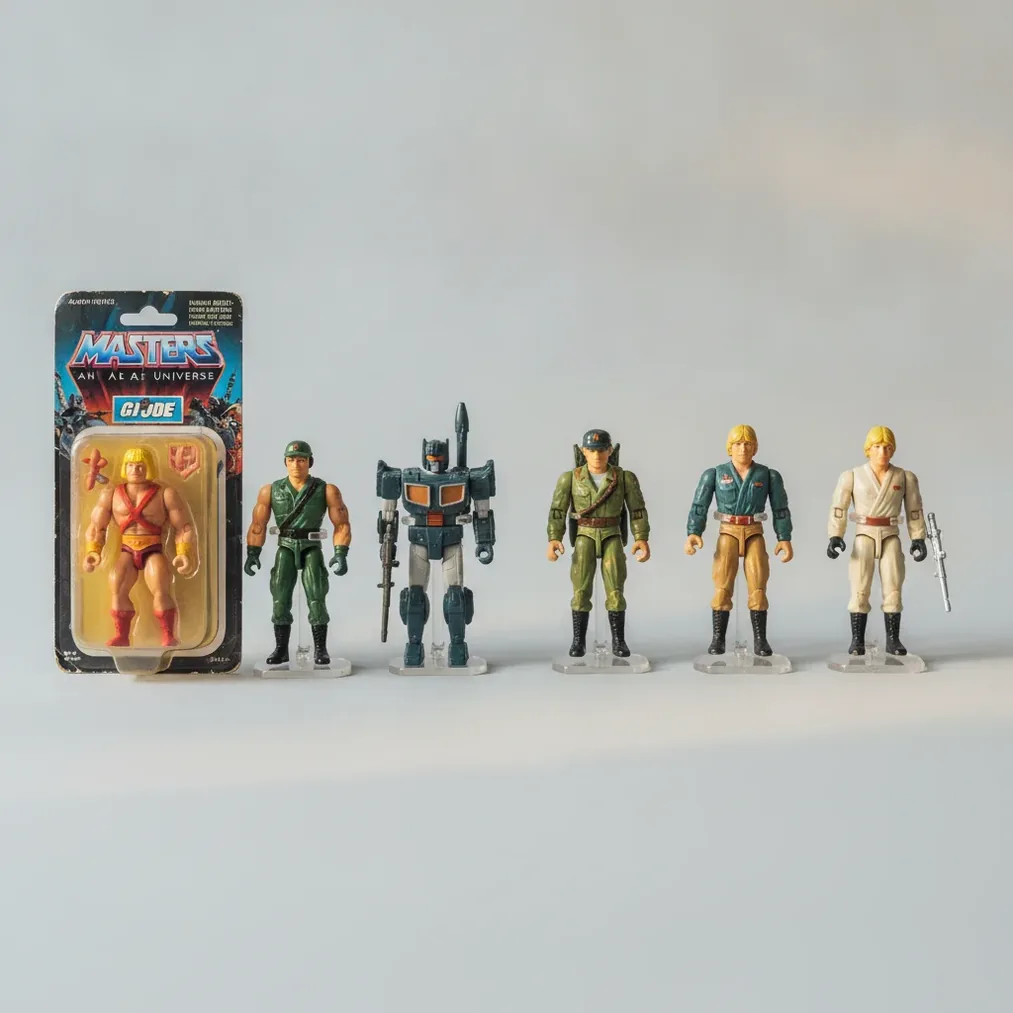
Recent toy sale examples and price benchmarks
Documented sales range from roughly $360 for a loose variant to $1.34 million for an exceptional prototype. These examples show why an ordinary figure should not be priced from a record sale unless the version, condition, packaging, and provenance match.
| Toy | Price | Venue and date |
|---|---|---|
| AFA-graded autographed Darth Maul | About $600 | eBay, 2025 market update |
| HasLab Razor Crest | About $375; typically $400–$450 on eBay including shipping and tax | Heritage Auctions and eBay, 2025 |
| HasLab Ghost | About $450 | Heritage Auctions and eBay comparisons, 2025 |
| Millennium Falcon Smugglers Run Edition | $487.50 at Heritage; commonly $600–$700 on eBay | Heritage Auctions and eBay, 2025 |
| Loose Blue Snaggletooth | About $360 | hobbyDB marketplace benchmark reported by Patina, pre-2026 |
| Loose and carded Yak Face | Near $1,000 loose; about $6,700 carded | hobbyDB-tracked benchmarks reported by Patina, through 2026 |
| Rocket-firing Boba Fett prototype | $1.34 million | High-end auction, 2022 |
How the toy value estimate is calculated
A photo estimate identifies visible traits and places the toy within a comparable resale range; it is not a certified appraisal. The result should be checked against dated sales for the exact release, variant, completeness level, and packaging state.
- Identify: Read manufacturer marks, dates, character details, packaging, and country of origin.
- Classify condition: Record paint wear, discoloration, joint tightness, broken pieces, box wear, and seal status.
- Inventory parts: Compare included accessories and paperwork with a known complete example.
- Match sales: Favor recent closed sales of the same version rather than unsold asking prices or a different reissue.
- Set a range: Use several relevant comparisons when available and explain any adjustment for condition or missing parts.
Photo tools cannot reliably confirm an untouched factory seal, authenticate an autograph, inspect hidden repairs, or guarantee that every accessory is period-correct. Toys potentially worth thousands may justify review by a specialist or an AFA/CAS grading assessment.
Where should you sell old toys?
eBay provides comparisons for many individual toys, while Heritage Auctions and specialist venues appear in documented sales of boxed, graded, and higher-value pieces. Choose a venue whose prior sales resemble the value and format of your item.
- eBay: Relevant to loose figures, complete toys, modern HasLab items, and many boxed collectibles; compare closed sales from 2025–2026 where available.
- Heritage Auctions: Documented 2025 sales include the $375 Razor Crest, roughly $450 Ghost, and $487.50 Smugglers Run Millennium Falcon.
- Specialist auctions and dealers: Used for top-grade boxed G1 Transformers reported around $16,000–$30,000.
Keep unusually valuable toys protected while obtaining an informed assessment. Circana reported that collectibles represented 18% of global toy volume and 15% of value sales in 2024, but a growing market does not make every old toy valuable.
Last reviewed: August 19, 2026.
For broader collectible-toy sales context, review Circana toy market research, which reported collectibles at 18% of global toy volume and 15% of value sales in 2024.
Check it with one photo
The scanner on this page gives you one free check. For unlimited scans, sold-price comparisons, and identification of coins, antiques, cards, and more, the free Lens app does the same job from your phone camera.
Frequently Asked Questions
How accurate are photo toy value estimates?
A clear photo can support identification and a resale range, but it cannot confirm every accessory, repair, seal, or hidden mark. Accuracy improves when you provide multiple images and compare the result with recent sales of the exact version.
How can I tell if a toy is vintage or a reissue?
Check molded date stamps, copyright lines, manufacturer names, and country-of-origin marks. Market guides specifically warn that modern retro releases can resemble original 1977–1985 Kenner Star Wars or 1980s G1 Transformers packaging while being worth far less.
Are toys from the 1980s and 1990s valuable?
Most loose 1980s and 1990s toys sell for about $5–$50. Rare variants, complete figures, unopened packaging, and top grades are the exceptions that can bring hundreds or thousands.
Does the original toy box increase value?
Yes. Opened boxed toys may sell for 3–8 times loose value, while factory-sealed or graded pieces can bring 10–20 times loose prices according to 2025–2026 market guides.
Are incomplete action figures worth anything?
Common incomplete figures usually fall around $5–$30. Original weapons, capes, missiles, and other small parts can move complete examples into the $30–$200+ range.
Should I get an old toy professionally graded?
Grading is most relevant to scarce, sealed, high-condition toys where authentication and condition affect a four- or five-figure price. AFA or CAS grading is not necessary to obtain a basic photo estimate for a common $5–$30 loose figure.
What old action figure brands can be valuable?
Collector guidance highlights Kenner Star Wars, G.I. Joe, G1 Transformers, Hot Wheels Redlines, and some early LEGO sets. Value still depends on the exact release, character, variant, condition, accessories, and packaging.